 Back to Blogs
Talk About a Revolution
Here’s a word association game: when you read “revolution,” what comes to mind? For students of Crystal Lamb and Jessica Freed, “Vietnam,” “Cambodia” and “China” didn’t. In fact, scores on their Global History state exam revealed an average of just 34% of students correctly answered questions related to these countries.
“In analyzing these results, we had to consider our own level of knowledge on these topics and how it may act as a barrier to our students’ success—not only on state exams but also in understanding the major economic and political revolutions that shaped the 20th century and continue to influence interactions between world powers today,” wrote Lamb and Freed in their Fund for Teachers grant proposal. “Upon reflection, we noted our limited knowledge on the topic, each revolution learned through the relationship with the United States and their foreign policy objectives of containment. This can also be reflected in the current curriculum we use which is dominated by documents with an American lens, discussions on stopping the spread of communism, and the role of the United States military within the region to promote this foreign policy.”
Last summer, they used a $10,000 Fund for Teachers grant to examine through the lens of art and culture the multifaceted perspectives of political and economic revolutions in China, Vietnam, and Cambodia to develop a culturally responsive curriculum that fosters critical thinking and an appreciation of multiple perspectives.
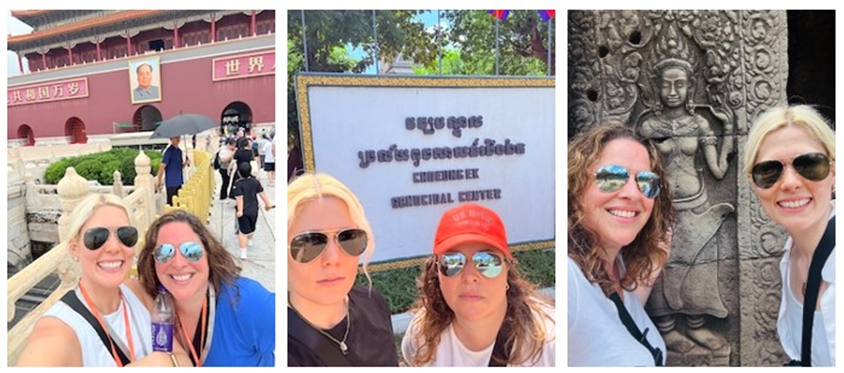
For two weeks, these FFT Fellows deepened their knowledge by interacting with people and experiencing sites integral to each country’s past (and future): learning about the legacy of Chairman Mao in mausoleums and museums; squeezing into underground tunnels dug by the Vietcong; and walking in Pol Pot’s Cambodian Killing Fields. They also experienced the spirituality of Angor Thom, calligraphy classes in Beijing and resistance at the Hanoi Hilton.
“I was changed by the opportunity to view history from the perspective of citizens of their country, understanding how viewpoints and perspectives vary greatly,” said Lamb. “I also benefitted from learning art practices from artists practicing in their country.”
Now their students at Bronx Bridges High School are benefitting from the fellowship, as well.
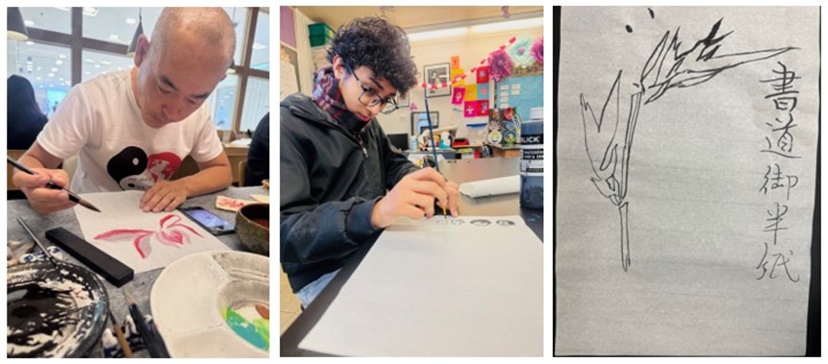
Recently, the teachers took students on a walking tour of Chinatown, where students learned about immigration and history and experienced new foods, with field trips to Vietnamese and Cambodian cafes and restaurants in the works. In Studio Art class, 9–12th grade students were introduced to the traditional calligraphy techniques we studied in Beijing, working with rice paper and natural-hair brushes. To provide authentic and direct instruction, students viewed videos Lamb filmed of their instructor in Beijing. This unit will culminate in the creation and presentation of a mini-museum display, with students from both Lamb and Freed’s classes incorporating artifacts, images, artwork, and propaganda collected throughout the fellowship to analyze how history is shaped by bias and perspective—learning to interpret history not as fixed, but as evolving and contested.
“Using photos from my experience has gotten history students very excited to learn not only about my experience, but to use my images to ground their learning,” added Freed. “I am seeing student interest and engagement grow in this topic as compared with previous years and am excited to see how the museum display projects turn out.”
“As educators, we must recognize that our understanding of history is influenced by dominant narratives, often reflecting the perspectives of those in power,” said Lamb. “By engaging with and interviewing locals, we gained insight into how these events are viewed by governments, historians, those in power, as well as those on the ground. And now this fellowship will continue to open doors for students and us to explore new perspectives and continually push back on biased or silenced narratives.”