MLK Jr, Mandela & Me

2018 Update: Since submitting this story, Diego shared this story:


“FFT was transformative, probably the best PD I have done as an educator. My fellowship in South Africa included a visit with Christo Brand, one of Mandela’s former prison wardens who eventually became Mandela’s friend, confidant and served with him when he became president. It worked out beautifully, as Mr. Brand visited my school in Fall of 2015 and FFT allowed me to travel for my fellowship in December of that year, so we stayed in touch and I had the chance to learn first hand about what it was like to be next to Mandela. This picture of Christo and me is right after visiting Robben Island on a beautiful crisp morning in Cape Town.


I’ve continued to use what I learned in my fellowship with my classes. All of my students read a chapter from Mandela’s Robben Island: The Dark Years, his memoir of his imprisonment, in a class called LeadServe, where we think about citizenship and civics. 


Teaching this class led me to be selected as one of 20 national fellows working with Citizen University, based out of Seattle, to think of new ways of bringing citizens together and engaging the through public “Civic Seminaries.” I trace this work directly to my learning as an FFT Fellow.”

by, Diego Duran-Medina – Estes Park, CO

For most of my social studies students at Eagle Rock High School, social justice is perceived as very US centric, mostly revolving around American historical figures like Martin Luther King, Jr. and Rosa Parks. I designed my Fund for Teachers fellowship to expand students’ knowledge base to an international context by researching social justice in South Africa. For two weeks, I explored the history, impact and legacy of apartheid and Nelson Mandela to gather lessons for students as they begin defining their own path within our progressive, restorative-justice based alternative school. In doing so, I’m facilitating students’ understanding of issues around social justice movements by comparing and contrasting the Civil Rights Movement with apartheid and reconciliation.
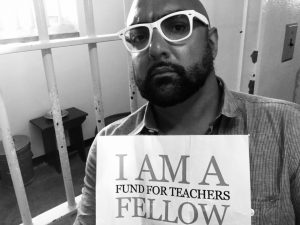
Fund for Teachers Mandela

Standing outside Mandela’s cell on Robben Island.

My passion for this fellowship comes from having spent over a decade developing my own curricula around issues involving access, social justice, civil rights, definitions of citizenship and exploring what it means to belong and exclude in different contexts. I have never been a traditional teacher relying on textbooks; instead, I prefer to create learning experiences around current events, historical narratives and issues that my students are interested in. This has to do with my own development as a student who always enjoyed history, but found it to be a subject that can often be reduced to static dates, rote memorization and mythology of “great (white) men.” My passion is driven by the fact I want students to know I continue to expand my knowledge and to actively seek new answers with new questions by traveling to a country and culture that I have never visited, but has always fascinated me – South Africa.


I chose to spend my fellowship observing and researching the Mandela Museum in Mthatha, the Apartheid Museum in Johannesburg, Mandela Square and the Mandela House in Soweto, because I believe that these places offer a perspective that can only be experienced by visiting and have become part of Nelson Mandela’s myth and legacy. By visiting sites over multiple days, I gathered detailed and thorough information to supplement my teaching and curriculum. I also interacted with educators and museum personnel to connect with those who were able to provide personal insight into Mandela’s life and legacy. As a result, I added an important layer of an international focus with an in-depth study of a historical figure beyond the usual pantheon of Civil Rights figures from the US context. My curricula will deepen with a specific example of social justice and a comparative model with apartheid for looking at slavery, oppression and freedom.

On January 6, I started a class called LeadServe, taking a hard look at what it means to work for democracy in different contexts: the two primary examples we will use are Martin Luther King, Jr. and Nelson Mandela. Students will learn though readings, historical context, connected facts and artifacts collected from my fellowship. They will develop a notion of history that moves beyond facts and moves from the impersonal to the personal (i.e.“What does this history mean for my own life?”) They will also develop skills in comparing and contrasting cultures, movements, societies and historical figures, specifically the U.S. and South Africa.


Being awarded this fellowship solidified for me that I can be a teacher who focuses on social justice and that my work has real meaning and substance. These stories need to be told to students in a way that goes beyond the classroom or the textbook, and the example I am setting by
traveling to South Africa is much more powerful than just a lecture on apartheid.

There’s a certain inspiration and renewal of the spirit that happens when I pursue these personal passion projects and it helps inject my career with new energy and
focus
. Also, as I advance in my career, I am committed to making sure that younger teachers understand the power of experiential learning for their practice and are able to implement similar experiences in their classrooms and curricula.

Learning through travel is the most powerful combination for connecting the classroom and community, the learning with the doing, and the present with the past. Therefore, I am extremely grateful for this opportunity and treasure the days I spent in South Africa, both learning and reflecting on my practice. I consider it an honor to have been selected as a Fund for Teachers Fellow and entrusted with representing myself, my school and my country.

Eagle Rock School is a full-scholarship high school for 72 adolescents who are not thriving in their current situations, for whom few positive options exist and who are interested in taking control of their lives and learning. Eagle Rock is also a Professional Development Center where educators from across the country learn how to re-engage, retain and graduate students. Diego plans to use his fellowship learning in both settings.

Creating a Craving for “Slow” Food

We live in a paradox, a society of consumption and waste paired with health concerns over rising obesity. The high prevalence of overweight children and unhealthy eaters within our student population highlights the importance of examining factors affecting their food choices. As educators with 27 years of collective experience in elementary education, we’ve witnessed positive changes to policies regarding school lunches and snacks, yet it is our belief that if students become more involved in the actual growing of healthy food while learning organic practices and sustainability, they are more likely to develop lifelong healthy eating habits and values consistent with sustainable living.

Hombre Farm, where organic cheese is produced and distributed locally

Therefore, we designed our Fund for Teachers fellowship to research the sustainable food movement in Italy by exploring organic gardens, specifically the first Zero-Waste town of Capannori, to influence organic gardening projects within the school community and influence students’ healthy food choices.

Italy is the European leader in organic farming, with approximately 45,000 operational organic farms – 2,300 in the Tuscan region alone. The demand for organic produce in Italy has grown significantly since World War II, thus sustainability has become a lifestyle, a culture among Italians countrywide. An essay written for NewFarm.org, states, “Italy is smaller than the state of New Mexico, but it has more land under organic management than does the entire United States.” We spent 14 days last summer researching organic farms in “the Green Heart of Italy” by:

  • Exploring Rome’s role in shaping Italy’s Slow Food movement (the city is also the seat of the United Nation’s Food & Agriculture Organization)
  • Interviewing owners of biological farmhouses and organic farms across Tuscany, the agricultural heart of Italy
  • Touring an Anaerobic Digestion Plant to learn about the composting process
  • Witnessing agriculture enhanced by a well-developed use of fertilizers and a wide net of irrigation systems in the Lombardy region
  • Observing in Milan the largest collection program of organics on the planet, and,
  • Experiencing the largest science and technology museum in Italy

The knowledge we acquired gave us the confidence and expertise to apply effective and efficient
teaching methods that will promote content-rich instruction. We now have the conviction and self-assurance in our understanding to share with and help other teachers, as well as our students, and to make their learning more meaningful.


Although the impact of our fellowship in the classroom and community is just beginning, it mirrors this year’s school theme, “From Small Beginnings Come Great Things at USE,” inspired by our fellowship and new school-wide garden. T-shirts bearing the slogan were made for all the staff and sold to students and families by the PTA.  With information acquired through our meeting with the town council of Capannori during our fellowship, we are expanding our school-wide recycling program, as well as the program that donates unopened milk and food items to non-profit organizations. We are also implementing a school composting program, run by our student council, to facilitate student awareness of how prior waste becomes nutrient rich soil.

Other plans for the academic year involve students tilling and planting phases of our newly constructed organic garden. Each grade level has their own plot to tend. Students researched and identified an organic source from which to purchase different types of seeds for our soil and climate. The effort also involves collaboration with science, math and writing teachers to form lessons that incorporate:

  • steps and phases of the gardening process to include research of beneficial insects
  • composting and fertilizing the soil
  • planting the seeds and tending the garden
  • communicating and writing about patience and observations as students wait, watch and wonder, and,
  • learning the significance of zero-kilometer and the slow-food movement.

Implementing the school recycle and less food waste program

Teachers long to have first-hand knowledge and we know how important it is that our students have it, as well.  When students lack personal experiences, teachers need to be prepared to compensate and build connections. We know that with hands-on, direct and personal experiences, learning at any age becomes more evident and meaningful offering higher chances of retaining and applying the information. For teachers to be awarded the chance [through Fund for Teachers] to lend possibilities to all types of diverse learners from disparate backgrounds is an incredible gesture of graciousness and generosity.  We had ideas and plans and hopes, and we were able to live those out and return  with a renewed sense of passion and purpose ready to share, to offer and to engage with what will remain with us for the rest of our lives.

UPDATE

This month, the science team at Stephens Elementary won a $5,000 grant from the KatyISD Education Foundation for their school garden!

Stacy Slater and Becca White teach at Ursula Stephens Elementary in Katy, TX. You can follow on Twitter progress of the new school garden at @StacylSlater or using hashtag #useitaly.  

An Epidemic of Statistics

When the Ebola outbreak caught the attention of my students, I looked for ways to capitalize on that interest and help them look at the global issue through the lens of statistical modeling – but I felt ill prepared. Most of the educational materials I found online were focused on the biology of pathogens and how to spot the symptoms. One student said, “The person on the news told me not to worry, that chances of getting Ebola are low. How low is low? And isn’t there a possibility?” As a Statistics teacher, I answered, “There is always a possibility.”

That answer did not satisfy my students, nor did it satisfy me. I want my students to know that I am the kind of teacher who listens to their questions and who takes their curiosity seriously. I designed a Fund for Teachers fellowship to deepen my understanding of mathematical modeling and statistics in the context of Public Health and Epidemiology in two phases over a three-week period. For the first phase, I participated in the “Introduction to Infectious Disease Modeling and Its Applications” course at the London School of Hygiene and Tropical Medicine; for the second phase I visited governmental,non-governmental, and academic institutions across the east coast of the United States.

Teaching, in many ways, is analogous to what Epidemiologists do: studying the spread of knowledge (instead of disease) and consistently planning and implementing intervention plans and measuring the impact of those interventions.

In London, I was introduced to this exciting and expanding area by professionals working on infectious diseases in both developing and developed countries. The emphasis was on developing a conceptual understanding of the basic methods and on their practical application, rather than the manipulation of mathematical equations. Back in the States, I met with experts at the Yale School of Public Health in New Haven, CT, Partners in Health in Boston, and National Institutes of Health in Bethesda, MD. I sat down with people who use Statistics in their careers to better understand the world around them, and made videos of our discussions to expose students to careers in fields that are not often covered in the media.

Throughout  my fellowship, I was reminded that learning in context is important. In math, topics can often seem random and as though you are marching through a disconnected series of rules and procedures. The learning I accomplished this summer is in a beautifully real-world context, which motivates me to keep going. I wanted to figure out the formula because I wanted to know how the average age of infection has changed since a vaccination has been introduced. After this experience, I am recommitted to the importance of students learning mathematics because so much of our understanding of science and society has foundations in algebra and statistics.

Through the lessons and projects built on the foundation of my fellowship, students will learn about careers in health and research that they can pursue and what academic background they would need to be prepared for those fields. I am excited to implement my senior-freshman health and mathematics writing buddy program this fall. I am working with the ten 9th grade Health Writing teachers to develop an Infectious Disease unit for which my AP Statistics students will serve as student mentors. I foresee great benefits for the seniors learning about writing in the math content area who will be able to turnkey that knowledge and become more confident through their work with freshmen.

I used to think about a career change from teaching to working in public health, but through my experience this summer I realized that I do work in public health- I teach statistical literacy and help students be responsible owners of their minds and bodies. I am recommitted to my career in education, realizing that I am able to effect the change I would want to through a different career right where I am.


Eleanor Terry Vierling has been teaching math at the High School for Telecommunication Arts and Technology (HSTAT) in Brooklyn, NY, for almost 10 years. She has taught everything form numeracy to AP Statistics. Five years ago, she also took on the role of college advisor.  In 2013, Eleanor was awarded the Sloan Award for Excellence in Teaching Science and Mathematics.

Bomb Cyclone = Climate Change?

Boston Public Schools closed today due to -20 degree wind chills. Sounds like the schools need some geothermal heating that Fellows Kristen Cacciatore and Mandy Dillingham researched in Iceland last summer with their Fund for Teachers grant.

These East Boston High teachers spent a week investigating the impact of climate change on Iceland’s society, educational system and natural environment to develop instructional resources that empower students to address climate change and its impacts on Boston.

“We designed our Fund for Teachers fellowship to go to the world’s leader in renewable energy generation. We gained new insight into how best to combat climate change by using renewable energy sources that do not produce carbon dioxide emissions in the place of fossil fuels. Our goal is to use these experiences and new knowledge to develop curricula that empower students to develop new ideas to change current energy practices in our school and community,” wrote Mandy.

The teachers found that Icelanders take pride in their use geothermal energy to heat water used in everything from homes to public swimming pools. After renting a car, the explored Hellisheidi, the second largest geothermal power station in the world (pictured above), hiked the Hengill Volcano and explored Pingvellir, the national park where two tectonic plates meet. They also toured an innovative greenhouse that grows tomatoes using 100% of its energy from geothermal heat.

Back in Boston (although not today) Kristen and Mandy teach a newly-developed curricula that addresses climate change and the use alternate forms of energy to alleviate carbon dioxide emissions that will be delivered to hundreds of students this year alone. They are also incorporating their fellowship learning into climate change activities with the Science Club they co-lead after school. Students are in the process of developing a series of fun, informative, video clips about climate change in our local area, and ways to conserve energy, which will be delivered on school-wide TVs.

“On our fellowship, we learned how a large community was able to vastly reduce its amount of carbon dioxide production by using geothermal heat and how this heat is converted to electricity to significantly improve the quality of life of Icelanders,” said Kristen. “And our adventures in Iceland have inspired our students to try to prevent global warming by changing how the energy they use every day is produced.”

You can learn more about their experiences on the blog they developed and updated daily for faculty, family, and students to follow.

An additional BPS teacher, Alex Pancic (Brighton High) also used his FFT grant to research energy in Iceland. Specifically, Alex enrolled in Reykjavik University’s School of Energy program to learn how Iceland maximizes alternative energy systems and incorporate these solutions, along with photos and interviews, into an Engineering for the 21st Century curriculum.

Casting a Vote for Relevant Statistics

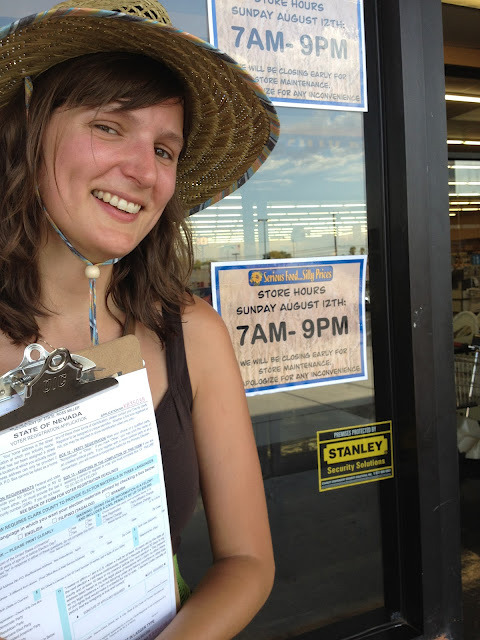
Ellie on her fellowship registering voters outside a grocery store in Las Vegas

Hispanics account for more than half of the U.S. population growth between 2000 and 2010, according to the U.S. Census. Yet, Ellie Terry’s Hispanic students at the High School of Telecommunication Arts & Technology in Brooklyn showed no interest in the upcoming presidential election. She designed a Fund for Teachers fellowship to engage them and fuel a real-world AP Statistics project at the same time.

“Sunset Park, my school’s neighborhood, is predominantly Hispanic. Few residents are politically active and my students felt that the presidential election didn’t involve them,” explained Ellie. “I wanted them to realize that, as Hispanic Americans, they make up the most empowered group of voters. Being a math teacher, I decided to use numbers to prove it.”

On her fellowship, she joined presidential campaign statisticians in the predominantly Hispanic swing states of Florida, New Mexico, Nevada, and Colorado to learn how they use statistical methods to research voter trends. She studied the design of surveys, conducted focus groups, and polled people by phone and in front of Walmart to gather data on Hispanic voters and their concerns. Political strategists used this information to craft candidates’ speeches; Ellie took the results back to Brooklyn to create math and civics lessons.

“The whole school is adopting Common Core State Standards, so I’m enlisting teachers from every discipline to join a three-day election project: History teachers will introduce students to the electoral college; science teachers will review candidates’ positions on the environment and health care; English teachers will show previous debates and assign students a side to argue,” Ellie explained.

Both her fellowship and the cross-curricular unit lead up to a school-wide mock election in November. Additionally, with permission from the board of elections in Kings County and assistance from 17 student teachers from Brooklyn College, 34 AP Statistics students will canvass polling places on Election Day. Students will collect data using class-designed exit surveys that will fuel their coursework for the rest of the school year.

“I feel as though I’ve earned a Master’s degree in statistical analysis after this fellowship. My mom was a teacher, as was her mom and her mom. I’ll be a teacher for life, but finding this type of enrichment is key to keeping me excited and my students informed.” You can read more about Ellie’s fellowship at hstatistics.blogspot.com.