2018 Update: Since submitting this story, Diego shared this story:
“FFT was transformative, probably the best PD I have done as an educator. My fellowship in South Africa included a visit with Christo Brand, one of Mandela’s former prison wardens who eventually became Mandela’s friend, confidant and served with him when he became president. It worked out beautifully, as Mr. Brand visited my school in Fall of 2015 and FFT allowed me to travel for my fellowship in December of that year, so we stayed in touch and I had the chance to learn first hand about what it was like to be next to Mandela. This picture of Christo and me is right after visiting Robben Island on a beautiful crisp morning in Cape Town.

I’ve continued to use what I learned in my fellowship with my classes. All of my students read a chapter from Mandela’s Robben Island: The Dark Years, his memoir of his imprisonment, in a class called LeadServe, where we think about citizenship and civics.
Teaching this class led me to be selected as one of 20 national fellows working with Citizen University, based out of Seattle, to think of new ways of bringing citizens together and engaging the through public “Civic Seminaries.” I trace this work directly to my learning as an FFT Fellow.”
by, Diego Duran-Medina – Estes Park, CO
For most of my social studies students at Eagle Rock High School, social justice is perceived as very US centric, mostly revolving around American historical figures like Martin Luther King, Jr. and Rosa Parks. I designed my Fund for Teachers fellowship to expand students’ knowledge base to an international context by researching social justice in South Africa. For two weeks, I explored the history, impact and legacy of apartheid and Nelson Mandela to gather lessons for students as they begin defining their own path within our progressive, restorative-justice based alternative school. In doing so, I’m facilitating students’ understanding of issues around social justice movements by comparing and contrasting the Civil Rights Movement with apartheid and reconciliation.
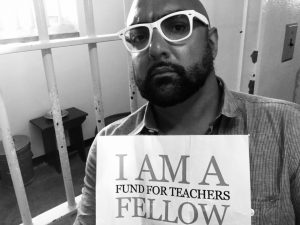
Standing outside Mandela’s cell on Robben Island.
My passion for this fellowship comes from having spent over a decade developing my own curricula around issues involving access, social justice, civil rights, definitions of citizenship and exploring what it means to belong and exclude in different contexts. I have never been a traditional teacher relying on textbooks; instead, I prefer to create learning experiences around current events, historical narratives and issues that my students are interested in. This has to do with my own development as a student who always enjoyed history, but found it to be a subject that can often be reduced to static dates, rote memorization and mythology of “great (white) men.” My passion is driven by the fact I want students to know I continue to expand my knowledge and to actively seek new answers with new questions by traveling to a country and culture that I have never visited, but has always fascinated me – South Africa.
I chose to spend my fellowship observing and researching the Mandela Museum in Mthatha, the Apartheid Museum in Johannesburg, Mandela Square and the Mandela House in Soweto, because I believe that these places offer a perspective that can only be experienced by visiting and have become part of Nelson Mandela’s myth and legacy. By visiting sites over multiple days, I gathered detailed and thorough information to supplement my teaching and curriculum. I also interacted with educators and museum personnel to connect with those who were able to provide personal insight into Mandela’s life and legacy. As a result, I added an important layer of an international focus with an in-depth study of a historical figure beyond the usual pantheon of Civil Rights figures from the US context. My curricula will deepen with a specific example of social justice and a comparative model with apartheid for looking at slavery, oppression and freedom.
On January 6, I started a class called LeadServe, taking a hard look at what it means to work for democracy in different contexts: the two primary examples we will use are Martin Luther King, Jr. and Nelson Mandela. Students will learn though readings, historical context, connected facts and artifacts collected from my fellowship. They will develop a notion of history that moves beyond facts and moves from the impersonal to the personal (i.e.“What does this history mean for my own life?”) They will also develop skills in comparing and contrasting cultures, movements, societies and historical figures, specifically the U.S. and South Africa.
Being awarded this fellowship solidified for me that I can be a teacher who focuses on social justice and that my work has real meaning and substance. These stories need to be told to students in a way that goes beyond the classroom or the textbook, and the example I am setting by
traveling to South Africa is much more powerful than just a lecture on apartheid.
There’s a certain inspiration and renewal of the spirit that happens when I pursue these personal passion projects and it helps inject my career with new energy and
focus. Also, as I advance in my career, I am committed to making sure that younger teachers understand the power of experiential learning for their practice and are able to implement similar experiences in their classrooms and curricula.
Learning through travel is the most powerful combination for connecting the classroom and community, the learning with the doing, and the present with the past. Therefore, I am extremely grateful for this opportunity and treasure the days I spent in South Africa, both learning and reflecting on my practice. I consider it an honor to have been selected as a Fund for Teachers Fellow and entrusted with representing myself, my school and my country.
Eagle Rock School is a full-scholarship high school for 72 adolescents who are not thriving in their current situations, for whom few positive options exist and who are interested in taking control of their lives and learning. Eagle Rock is also a Professional Development Center where educators from across the country learn how to re-engage, retain and graduate students. Diego plans to use his fellowship learning in both settings.

 Although the impact of our fellowship in the classroom and community is just beginning, it mirrors this year’s school theme, “From Small Beginnings Come Great Things at USE,” inspired by our fellowship and new school-wide garden. T-shirts bearing the slogan were made for all the staff and sold to students and families by the PTA. With information acquired through our meeting with the town council of Capannori during our fellowship, we are expanding our school-wide recycling program, as well as the program that donates unopened milk and food items to non-profit organizations. We are also implementing a school composting program, run by our student council, to facilitate student awareness of how prior waste becomes nutrient rich soil.

“I feel as though I’ve earned a Master’s degree in statistical analysis after this fellowship. My mom was a teacher, as was her mom and her mom. I’ll be a teacher for life, but finding this type of enrichment is key to keeping me excited and my students informed.” You can read more about Ellie’s fellowship at hstatistics.blogspot.com.