Charlotte Brontë, who sent her Jane Eyre manuscript to a London publisher on this date in 1847, wrote, “Your claim to superiority depends on the use you have made of your time and experience.” This summer, Amanda Kingston (Odyssey Leadership Academy – Oklahoma City) used her time (and a Fund for Teachers grant) to research the Brontë sisters, especially Charlotte – regarded as “the first historian of the private consciousness.”
On my Fund for Teachers fellowship, I navigated through five European countries in the hopes of learning more about Carol Gilligan’s work on the ethic of care in connection to the lives and histories of women. Among the women I journeyed to “meet” were Charlotte, Emily, and Anne Brontë, authors and sisters.
Haworth, England, is a small town that has capitalized on the mythology of the Brontë family. It’s hard to know if the Brontës modeled their stories after the environment of Haworth, or if Haworth has wrapped itself up in the Brontës. Whether it’s chicken or egg, at the heart, they’re inseparable. And, if you can’t get enough of the gothic atmosphere, you can hike out to the Brontë Waterfall across the moors and even farther to Top Withens, a possible location for the Wuthering Heights of Emily’s imagination. In the mist and among the heather you can almost hear Cathy still calling for Heathcliff.
The Brontë Parsonage Museum itself is in the midst of celebrating the 200th anniversaries of the Brontë children: for 2017, this is Branwell. The small parsonage is preserved beautifully, with portraits of the family hung in each room; the table where the women bent over needlework, writing, and dinners; and the study of the family patriarch, Patrick Brontë, complete with his spectacles and magnifying glass. The staff were enthusiastic and kind, offering up knowledge about the family not with an air of pretension, but rather as though talking warmly about old friends. The Brontës are very much real people to this crowd. Prior to this fellowship, I did not know much about the Brontës. I did a quick reread of Wuthering Heights and Jane Eyre earlier this year, and watched the BBC television special To Walk Invisible. The production worked closely with the Brontë Society and the museum also includes stills and costumes from the series.
For more on Jane Eyre’s iconic line “Reader, I married him,” click here.
In researching before the trip, I learned that in the original publications, the sisters chose not to use their given names. Instead, they used pseudonyms: Currer, Ellis, and Acton Bell. Charlotte explained after the deaths of Emily and Anne in 1848 and 1849 respectively, they wanted their work taken seriously, not frowned upon as womenly nonsense nor praised patronizingly as female folly. The Brontës were real writers with real things to say about the real world around them. And really, in 1847 when Jane Eyre was published, only male authors were taken seriously. The museum even includes a letter from a poet Charlotte admired advising her that writing was not for women.
I realized, a few days before in Chawton, that there is a reason we don’t say that Jane Austen’s books are about the human experience, though they certainly include suffering, trials, family, love, and loss. (The Jane Austen Society, coincidentally, is celebrating her life with the bicentennial of her death this year, as well.) The Brontës recognized this also, and when Charlotte sent Jane Eyre to be published she wanted the story of a young governess, a deeply misguided Mr. Rochester, and a “madwoman” in the attic to be a story received with the utmost sincerity and gravity, a story of human experience- not just male or female. And it was: Jane Eyre became the talk of London and new editions came out almost immediately. It’s a story of human experience and human emotions that belong to all of us, and I believe people recognized this, despite knowing the true identity of the author.
I’ll be honest, I was not a Brontë fan before visiting the parsonage. I enjoyed their books, yes, and they were interesting figures to me. But I wasn’t a “fan.” However, there is something about walking in the home of a person, seeing their correspondence and their village, walking across the moors of their lives for even just a day that spins stories to a different light. It makes you not just a fan, but a friend. I learned more about their heart and the courage they had to put their stories out to the world, and to put themselves in their stories.
I don’t think that it’s any accident that the original title of Charlotte’s first novel was Jane Eyre: An Autobiography.
Amanda serves as both a mentor and humanities teacher at Odyssey Leadership Academy in Oklahoma City and previously worked as a teacher in Louisiana’s public education sector. She is passionate about creating courses that focus on justice and empowering students to enrich and transform the community around them.
The Politics of Music
As tensions heated up this summer between Russia and the United States, Kathy Morse served as a self-appointed ambassador of education, researching the arts in St. Petersburg, Novgorod and Moscow. She returned to ACESWintergreen Interdistrict Magnet School in Hamden, CT, with insight into how the arts plays such a vital role in Russia’s past and present culture and shares a few of her experiences below…
Before leaving on my fellowship, I asked my fifth graders to journal their impressions of Russia. Their input framed my research, which I will now use as the foundation for their sixth grade social studies class. Together, we will now look at our diverse world through the common lens of art, specifically, the music, dance and architecture I experienced with my Fund for Teachers grant.
For three weeks, I observed how culture is a driving force in Russia. In St. Petersburg, also known as “Venice of the North,” I explored the arts, history and geography of the city (the famed music conservatory, the Vaganova Ballet Academy and the State Hermitage Museum) while attending the Stars of the White Nights Festival. Specifically, I dove into the compositional techniques of Dimitri Shostakovich and his inspiration for his Seventh Symphony during the winter of 1941.
Next, I traveled to a city fixed in time, Novgorod, which lies between St. Petersburg and Moscow. At its peak during the 14th century, Novgorod was one of Europe’s largest cities and was recognized by UNESCO as a World Heritage Site in 1992. Novgorod has maintained itself as a historical center and it is possible to get a glimpse of what Russia looked like hundreds of years ago going back as far as the Middle Ages. This gave me a deeper historical context of Russia.
Continuing on to Moscow, I spent three days exploring the Kremlin, Red Square, St. Basil’s Cathedral, museums and attending performances at the Bolshoi Theatre. These sites are the most iconic, so I wanted students to know what they mean for the Russian people, as well as the importance Moscow plays in our world today.
Understanding WWII through the eyes of the Russian People by exploring Victory Park and the Museum of the Great Patriotic War (WWII) in Moscow was an extensive history lesson. This country lost more than 25 million citizens to battle, starvation, disease and Stalin’s Terror. The museum also emphasizes the important role the United States and other Allies played in securing victory over Nazi Germany.
Using the Lincoln Center Education model of inquiry (practicing skills like noticing deeply, posing questions, making connections, and empathizing), my students and I will now be able to explore the Russian culture through the study of the arts of St. Petersburg, the history of Novgorod and the political importance of Moscow while making real world connections to other curriculum areas including literature, history and geography. If we Westerners hope to understand this enormous country, we might intelligently begin by trying to understand the culture which drives this mysterious country. That’s where we’ll begin in my class.
Kathy Morse (pictured in a Moscow subway station) graduated from Duquesne University with a degree in Music Education/Music Therapy while pursuing her passion of performance on the
French Horn. Her first job was with the State Orchestra of Mexico. Upon returning to the United States, she earned her Masters Degree from Yale University and toured world wide with various ensembles. She has carried her passion for music into the classroom for the past 26 years and has led teacher workshops for Carnegie Hall and the New York Philharmonic.
International Day of the World’s Indigenous People
August 9th marks the first meeting of the United Nations’ Working Group on Indigenous Populations in 1982 and the occasion designated by the UN General Assembly for honoring 370 million Indigenous People living across 90 countries who remain subject to political, economic and social oppression.
Indigenous People are defined as ethnic groups originally in a territory prior to being
incorporated into a national state, and who are politically and culturally separate from the majority ethnic identity of the state that they are a part of.
This summer, fourteen Fund for Teachers Fellows chose to research Indigenous People on three continents to increase student awareness and appreciation of the history, culture and challenges faced by those also known as first peoples, aboriginal peoples and native peoples. Read on to see how these teachers pursued knowledge of and experience among these inheritors and practitioners of unique cultures and ways of relating to people and the environment.*
Charles FitzGibbon and Christine Faye Dunbar (Metropolitan Expeditionary Learning School– Forest Hills, NY) used photo journalism and oral interviews to examine the immediate effects of climate change on coastal Alaskan natives. They plan use their research to convey to students the interaction between individuals, communities, government policy and the climate.
Charles inspecting ice caves beneath Mendenhall Glacier on a hot day in Juneau, AK.
Their excellent blog documenting the fellowship begins:
“We are two teachers from a public 6-12 school in Queens, New York, who are traveling this summer to Alaska on a research grant from Fund for Teachers. We’re passionate about the work we engage our students in, and strive to make learning as relevant and real-world as possible. Our mission this summer is to research the impacts of climate change on coastal
communities, particularly those in the arctic region who are facing the more drastic effects of warming temperatures, melting permafrost, and land erosion. Namely we seek to answer three key research questions:
What challenges do coastal Alaskan communities face in the age of climate change?
How do borders ensure, enshrine, and entrap the communities of coastal Alaska?
What can be done to preserve and affirm the cultures of indigenous peoples as climate change threatens the future of their communities?”
For 21 days, Christine and Charles explored Juneau, Nome, Shishmaref, Fairbanks, and Prudhoe Bay, providing a broad scope of how climate change is impacting the state, its economy and social fabric. Click hereto see what they discovered.
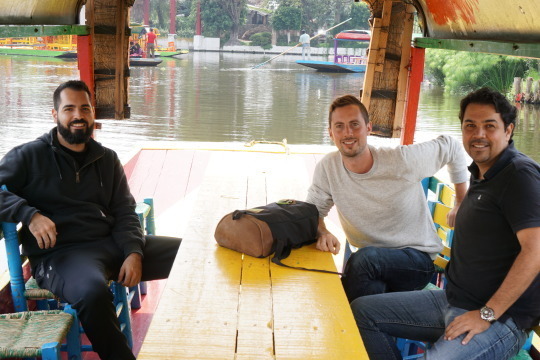
Glen Meinschein, Greg Gentile and Alejandro Avalos (Brooklyn School for Collaborative Studies) investigated of one of the most controversial figures in Mexican history, “La Malinche,”
by exploring across Mexico themes of colonialism, feminism and indigenous history to engage students of different backgrounds and support their academic achievement.
This blog documents their experiences, characterized by the sentence, “It was unsettling how much of our investigation of her has resulted in silence, shrugs or lack of any answers or any significant information.”
Exploring Xochimilco, a part of Mexico City where Aztecs built floating islands, or chinampas.
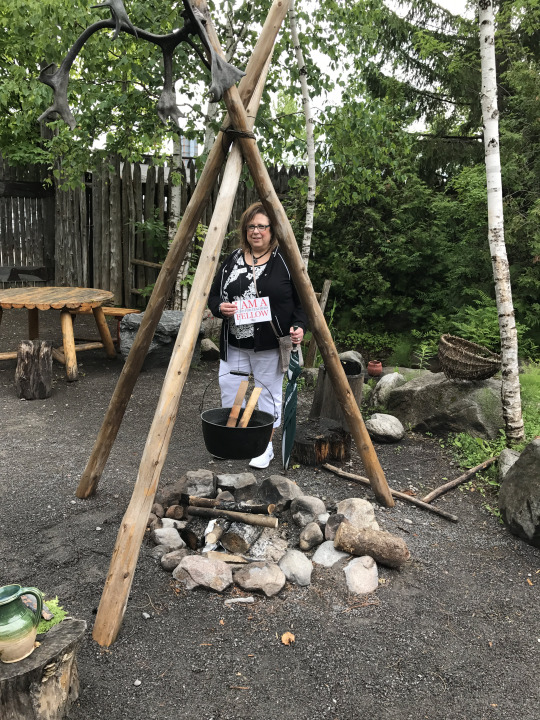
Learning about the Huran Wendat tribe on the Wendake Reservation.
Renee Lukaniec (Fox Run Elementary – Norwalk, CT) was handed a curriculum, outdated textbooks and asked to teach a unit on Native Americans three years ago. The search for authentic information and artifacts inspired her Fund for Teachers fellowship living and learning on the Huron-Wendat Nation reservation in Quebec. Read more of her experiences here.
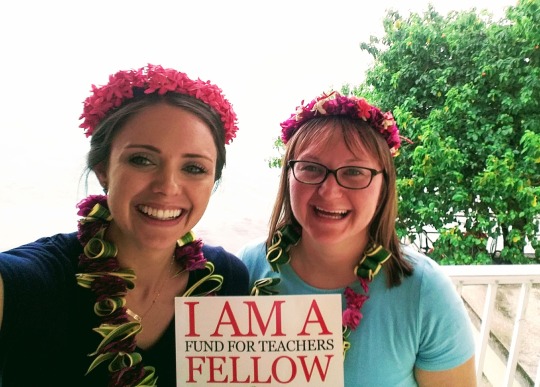
Michelle Broxterman and Rachel Southard (Westside Elementary – Pittsburg, KS) chose to investigate with their Fund for Teachers grant the Mashallese people, culture and environment because their classes increasingly welcome immigrants from the cluster of small islands in the Pacific Ocean. Despite the contingency of immigrants living in their small town, the teachers found that many people have no idea where the Marshall Islands are. Their goal is to reach, teach and assimilate Marshallese students and families – and to educate the community about their new neighbors. In their grant proposal, Michelle and Rachel wrote:
“The Marshall Islands face numerous obstacles resulting from global warming and continued effects of nuclear testing. According to scientists, the Marshall Islands could be underwater within our lifetime. These looming threats have resulted in a mass immigration of over 20,000 Marshallese people living in the US. Although there has been a large influx of Marshallese people, their language and culture are relatively unknown and seem to be gradually disappearing along with their islands. We feel an urgency to gain as much information as we can now because later may not be an option.”
Rachel and Michelle checked in after their fellowship:
Our fellowship took us to Majuro, the capital of the Marshall Islands, for an amazing experience. We were able to ride on a traditional Marshallese canoe, sample local foods and gain a deeper understanding of the nation’s history. In addition, we studied the Marshallese educational system and toured an elementary school.
The most meaningful part of our fellowship was spending time with the people. We were welcomed with open arms by relatives of our Marshallese students. They ensured that we were able to learn a large amount of
information in a short period of time. It was obvious that generosity, caring, resilience and hospitality were and continue to be key attributes in the Marshallese culture. It is our hope that from our fellowship, we will help our Marshallese students to be proud of their heritage and continue on their traditions.
Additional 2017 Fellows focusing on First Peoples include:
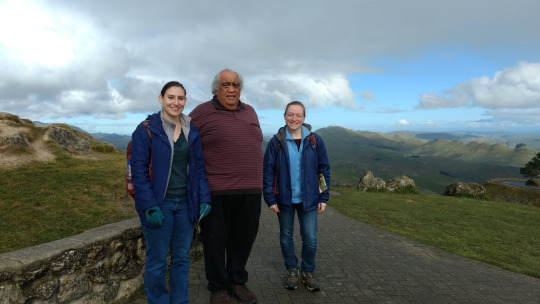
Kelly Shea and Sherry McCullough – Meeting with Maori guides and professors from the University of Auckland in New Zealand,to learn how the Maori use storytelling to represent cultural values and unify community for a new “Power of Language” unit (pictured above with guide Robert McDonald on top of Te Mata Peak).
Rebekah and Robert Polemeni – Investigating in five national parks the impact of climate change, with a specific focus on drought and indigenous peoples, to guides students’
creation of a local service project based on water conservation.
Amy Manware – Volunteering with conservation groups and native communities in Hawaii to
learn about ecological restoration, explore the impact of water on ecosystems and create blended learning activities that integrate Next Generation Science Standards and enrich STEM and instructional technology curricula.
David Hunt – Investigating the effect of 1800’s Westward Expansion on the American
Tribes of Arizona, Oklahoma, South Dakota and Montana to better teach topics including The Trail of Tears, Battle of Apache Pass and surrender of Geronimo, Battle of Wounded Knee and the Battle of Little Big Horn.
Judie Cavanaugh – Exploring the art and culture of Indigenous Peoples of the Pacific
Northwest to integrate art lessons with social studies curriculum.
Rebecca Cutkomp – Exploring Washington’s Spokane Indian Reservation and Alaska’s Denali National Park to enrich student learning in thematic units on identity and aid in students’ deeper insight into rhetorical analysis.
Timothy Kiser and Vincent McCollum – Exploring Dominica’s history and geography through an intersectionality lens of race and colonization to better understand two central questions: How did the Kalinago survive while others did not? and why do the Kalinago continue to thrive? And,
Samantha Verboven – Observing Alaska’s Native American population and the culture of
storytelling to create a after school writing club based on reader’s theater designed to improve oral storytelling techniques and the narrative writing process.
Click on the following links for further research accomplished by previous Fund for Teachers Fellows on:
Supriya Kotagal reclaimed her time in an airport to send us these beautiful images and update from her fellowship. Supriya used a Fund for Teachers grant to explore the methodology and best practices of community-based efforts in the Maldives and Solomon Islands to mobilize youth in island nations and Brooklyn confronting climate change.
“My hope,” she wrote in her proposal, “hope is that my fellowship experience will enable me to leverage both of these foci as my students engage in their design thinking work. Ultimately, I hope that ideas generated in my classroom around climate change can begin to be applied to the pressing issues that impact the neighborhood our school serves. I hope to mobilize my own students to be natural drivers of change in their community by creating a student advisory board or governing organization with my colleagues where youth weigh in on key problems and solutions that can better their neighborhood and school experience.”
Read more about her learning that will precede student advocacy.
As I type this, I am at the airport in Abu Dhabi waiting for my connecting flight to take be back to New York City. I think this is probably the perfect time to reflect on the experience and provide you with some closing thoughts and some of my favorite videos from my time abroad:
Through my Fund for Teachers fellowship, I set out to document the impact climate change is having on small island developing states in the Indian Ocean – specifically the Maldives
and Zanzibar. Providing tangible examples of how climate change is impacting ecosystems and people is incredibly important to me as a science educator. We are living in a time when the impacts of climate change are deemed “debatable” by some and my goal was to make this environmental crisis as tangible as possible for my students. I did this by collecting qualitative data in the form of interviews, photographs, and film clips in order to create “Country Kits” that will enable my seventh graders to explore climate change more deeply. As part of my “Country Kits” I am also producing several mini-documentaries that help explain different environmental issues and innovative solutions I encountered along the way.
Another aspect of my fellowship was to explore sustainable, community-based efforts that empower youth to tackle the very real challenges of climate change and to use this information to engage my students in thinking more globally about the environment. In the Maldives, I partnered with a sea turtle rehabilitation center called Naifaru Juvenile which seeks to spread awareness about the endangered sea turtle population and create sustainable solutions to protecting beaches and improving waste management–both environmental issues that stem from climate change and directly impact the sea turtle population. I met some amazing young activists who helped organize and participate in a festival bringing awareness to their local community. I was able to interview young people who are developing ways to improve environmental outcomes in their community. One young woman I met started a fashion line where she develops bags and purses from the trash she finds on the beach!
In Zanzibar, I explored how the country’s seaweed industry is being impacted by rising ocean temperatures. I met with a seaweed scientist and attended a community festival aimed at promoting the local development of seaweed products as a way of providing supplemental income to seaweed farmers, the majority of whom are women and who have seen recent declines in profit because of climate change. I also met with a collective of female seaweed farmers who are trying to create innovative products from the seaweed they cultivate in order to support their families. Additionally, I formed a valuable partnership with a youth organization called Zanzibar Learning 4 Lifethat seeks to encourage young people to become environmentally engaged and develop sustainable solutions to the problems that affect their community. I learned of some amazing work and ideas young people are formulating including using discarded plastic water bottles as bricks for water tanks. I hope to develop a deeper partnership with this organization in my classroom and am working on creating a pen-pal partnership between my students and theirs.
I wanted to share with you two mini-documentaries I made. The first [above] explains the seaweed industry in Zanzibar and the changes female farmers are making there in the face of climate change to maintain a profit. The second shares the perspective of youth on the island of Naifaru, the Maldives on the environmental issues impacting sea turtles and what needs to be done.
Thanks again for such an amazing opportunity. I can’t tell you how valuable this experience has been in re-energizing my passion for this work.
Best,
Supriya
(photo below of a group of young girls getting ready to dance at the youth-led “Turtle Festival” in Naifaru, the Maldives)
Supriya, middle school teacher at The School at Columbia University, is a curriculum designer, consultant and educator who has been involved in the field of education for ten+ years. She was a 2007 Teach for America Corps Member, a New York Hall of Science Design Fellow & Master Teacher, a New York Public Library Cullman Fellow in Creative Writing and currently teaches a STEAM* science course in New York City. Through her experiences, she understands education to be a powerful and transformative tool in uplifting individuals and communities.
Frank Mangan and Brandon Hubbard-Heitz (The Howard School – Chattanooga, TN) are assessing the past and present effects of people’s interaction with the Alaskan wilderness to empower students to embark upon future conservation work in their contexts.
You can follow their learning on Twitter and read more about their adventure below…
“Late in life, noted naturalist John Muir traveled to Alaska. As he sailed along Alexander Archipelago, he wrote,“To the lover of pure wildness Alaska is one of the most wonderful countries in the world. No excursion that I know of may be made into any other American wilderness where so marvelous an abundance of noble,newborn scenery is so charmingly brought to view…”
Today especially, Alaska stands out for its 54 million acres that have been set aside as national parks, a vast expanse of wilderness that can only be appreciated by the naked eye. Even so, Alaska’s history is also a decidedly human tale of exploitation as much as conservation, abuse as much as preservation. From the migration of humans across the Bering Strait to the gold rush to the ExxonValdez, Alaska is a microcosm of the human-nature relationship within American history. Thus, it offers itself as an excellent starting point for an exploration of this dialectic that has defined the American people’s relationship with their land.
Unfortunately, this relationship often goes unexplored by students at the urban high school in which we teach. The school primarily serves children of color, many of whom lack the resources to explore the local,state, and national parks near their neighborhoods. According to the Outdoor Foundation, only 8% of black adolescents and 12% of Hispanic adolescents participated in outdoor activities in 2015, miniscule numbers compared to 71% of their white peers.As America grows increasingly diverse, this gap portends significant consequences not only for communities of color, but for the earth itself. The damaging effects of human-caused climate change are increasingly manifest and necessitate an “all hands on deck” response – one that is only possible if all people, including our students, become advocates for conservation.
Our self-guided fellowship into Alaska’s wilderness will enable us to report back to our students not only its beauty, but also the imperative to preserve that beauty. As a U.S. history teacher and an English teacher who teach juniors, we will equip our students to step into the wilderness – Alaskan and local, past and present – in order to experience the wonder of the earth and the need to preserve it for future generations. Like Muir, we are documenting our adventure, in writing and digitally, in order to create a meaningful experiential unit that transports students to the Alaskan wilds with the aim of inspiring students to seek out such experiences for themselves while also advocating for the preservation and protection of the natural world.”
Armed with a 360 degree camera, Frank and Brandon are capturing experiences for their students, including:
Observing the impact of the ExxonValdez oil slick and climate change on Kenai Fjords National Park;
Witnessing the human-nature relationship on Reeve’s Field, the airstrip used to support the Pacific Theater during World War II;
Exploring in Denali National Park and Preserve the Kantishna Mining District;
Flying above the Arctic Circle to tour Simon Paneak Memorial Museum,
which documents the natural, geological and cultural history of the Nunamiut people;
Backpacking in lands preserved by the
Alaska National Interest Lands Conservation Act
In addition to incorporating images and experiences into U.S. History and English III classes, the teaching team plans to collaborate with colleagues to create an experiential interdisciplinary unit that promotes outdoor engagement and conservation. They also believe their experiences will help grow the school’s Outdoor Leadership Club, which Brandon founded last year. Lastly, students will visit a local tract of land managed by the National Park Service, interviewing rangers about local issues that interact with what their teachers learned in Alaska. Students’ research will culminate in a joint English – U.S. History research and advocacy project they’ll present to peers, teachers, parents, community members and park rangers.
Brandon is dedicated to preparing his students for active citizenship in the world by infusing his classes with authentic reading and writing. In 2016, he co-founded the school’s Outdoor Leadership Club in an effort to diversify the outdoors and expose students to the beauty of nature. In addition to being a Fund for Teachers Fellow, Frank has received a Teaching American History grant and studied the Civil Rights Movement at Cambridge University through the Gilder-Lehrman Institute.
MLK Jr, Mandela & Me
2018 Update: Since submitting this story, Diego shared this story:
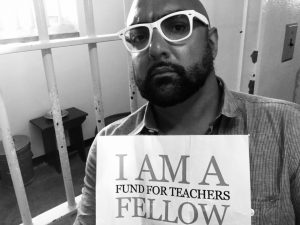
“FFT was transformative, probably the best PD I have done as an educator. My fellowship in South Africa included a visit with Christo Brand, one of Mandela’s former prison wardens who eventually became Mandela’s friend, confidant and served with him when he became president. It worked out beautifully, as Mr. Brand visited my school in Fall of 2015 and FFT allowed me to travel for my fellowship in December of that year, so we stayed in touch and I had the chance to learn first hand about what it was like to be next to Mandela. This picture of Christo and me is right after visiting Robben Island on a beautiful crisp morning in Cape Town.
I’ve continued to use what I learned in my fellowship with my classes. All of my students read a chapter from Mandela’s Robben Island: The Dark Years, his memoir of his imprisonment, in a class called LeadServe, where we think about citizenship and civics.
Teaching this class led me to be selected as one of 20 national fellows working with Citizen University, based out of Seattle, to think of new ways of bringing citizens together and engaging the through public “Civic Seminaries.” I trace this work directly to my learning as an FFT Fellow.”
by, Diego Duran-Medina – Estes Park, CO
For most of my social studies students at Eagle Rock High School, social justice is perceived as very US centric, mostly revolving around American historical figures like Martin Luther King, Jr. and Rosa Parks. I designed my Fund for Teachers fellowship to expand students’ knowledge base to an international context by researching social justice in South Africa. For two weeks, I explored the history, impact and legacy of apartheid and Nelson Mandela to gather lessons for students as they begin defining their own path within our progressive, restorative-justice based alternative school. In doing so, I’m facilitating students’ understanding of issues around social justice movements by comparing and contrasting the Civil Rights Movement with apartheid and reconciliation.
Standing outside Mandela’s cell on Robben Island.
My passion for this fellowship comes from having spent over a decade developing my own curricula around issues involving access, social justice, civil rights, definitions of citizenship and exploring what it means to belong and exclude in different contexts. I have never been a traditional teacher relying on textbooks; instead, I prefer to create learning experiences around current events, historical narratives and issues that my students are interested in. This has to do with my own development as a student who always enjoyed history, but found it to be a subject that can often be reduced to static dates, rote memorization and mythology of “great (white) men.” My passion is driven by the fact I want students to know I continue to expand my knowledge and to actively seek new answers with new questions by traveling to a country and culture that I have never visited, but has always fascinated me – South Africa.
I chose to spend my fellowship observing and researching the Mandela Museum in Mthatha, the Apartheid Museum in Johannesburg, Mandela Square and the Mandela House in Soweto, because I believe that these places offer a perspective that can only be experienced by visiting and have become part of Nelson Mandela’s myth and legacy. By visiting sites over multiple days, I gathered detailed and thorough information to supplement my teaching and curriculum. I also interacted with educators and museum personnel to connect with those who were able to provide personal insight into Mandela’s life and legacy. As a result, I added an important layer of an international focus with an in-depth study of a historical figure beyond the usual pantheon of Civil Rights figures from the US context. My curricula will deepen with a specific example of social justice and a comparative model with apartheid for looking at slavery, oppression and freedom.
On January 6, I started a class calledLeadServe, taking a hard look at what it means to work for democracy in different contexts: the two primary examples we will use are Martin Luther King, Jr. and Nelson Mandela. Students will learn though readings, historical context, connected facts and artifacts collected from my fellowship. They will develop a notion of history that moves beyond facts and moves from the impersonal to the personal (i.e.“What does this history mean for my own life?”) They will also develop skills in comparing and contrasting cultures, movements, societies and historical figures, specifically the U.S. and South Africa.
Being awarded this fellowship solidified for me that I can be a teacher who focuses on social justice and that my work has real meaning and substance. These stories need to be told to students in a way that goes beyond the classroom or the textbook, and the example I am setting by
traveling to South Africa is much more powerful than just a lecture on apartheid.
There’s a certain inspiration and renewal of the spirit that happens when I pursue these personal passion projects and it helps inject my career with new energy and
focus. Also, as I advance in my career, I am committed to making sure that younger teachers understand the power of experiential learning for their practice and are able to implement similar experiences in their classrooms and curricula.
Learning through travel is the most powerful combination for connecting the classroom and community, the learning with the doing, and the present with the past. Therefore, I am extremely grateful for this opportunity and treasure the days I spent in South Africa, both learning and reflecting on my practice. I consider it an honor to have been selected as a Fund for Teachers Fellow and entrusted with representing myself, my school and my country.
Eagle Rock School is a full-scholarship high school for 72 adolescents who are not thriving in their current situations, for whom few positive options exist and who are interested in taking control of their lives and learning. Eagle Rock is also a Professional Development Center where educators from across the country learn how to re-engage, retain and graduate students. Diego plans to use his fellowship learning in both settings.
 Before leaving on my fellowship, I asked my fifth graders to journal their impressions of Russia. Their input framed my research, which I will now use as the foundation for their sixth grade social studies class. Together, we will now look at our diverse world through the common lens of art, specifically, the music, dance and architecture I experienced with my Fund for Teachers grant.
 Understanding WWII through the eyes of the Russian People by exploring Victory Park and the Museum of the Great Patriotic War (WWII) in Moscow was an extensive history lesson. This country lost more than 25 million citizens to battle, starvation, disease and Stalin’s Terror. The museum also emphasizes the important role the United States and other Allies played in securing victory over Nazi Germany.