 Back to Blogs
Bringing the Origins of American Democracy to Life
With midterm elections approaching, television ads are filling the airwaves with competing politicians proclaiming their visions of democracy and how best to achieve it. The rhetoric can leave adults confused—and fifth graders even more bewildered.
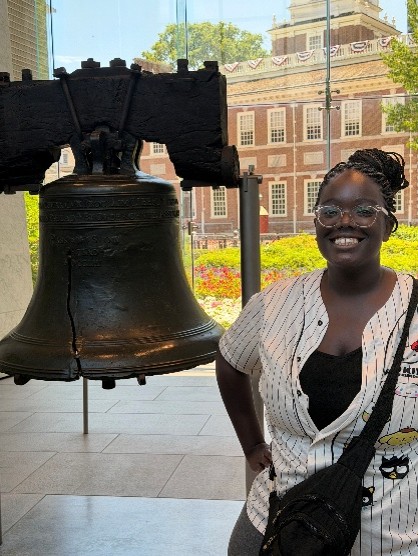
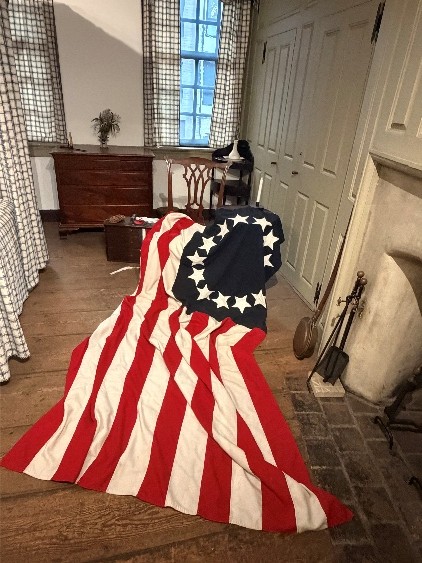
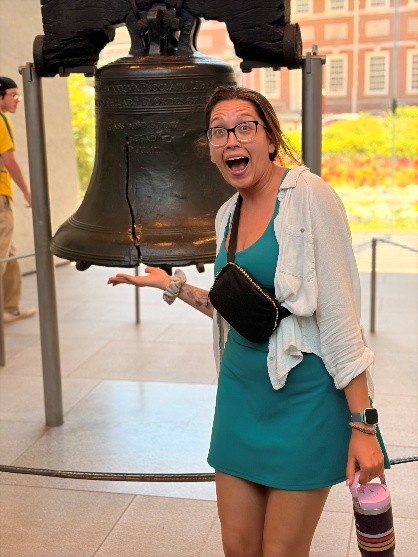
This summer, Nkiru Nwadiwe and Valerie Fresh, teachers at CHIME Institute Schwarzenegger Community School in Woodland Hills, California, set out to change that. Using a $10,000 Fund for Teachers grant, they stepped back in time to explore the experiences, perspectives and struggles of America’s colonial citizens, gathering firsthand insights to help their students better understand the origins of American democracy.
“We teach foundational concepts of government and democracy, and we recognize the responsibility that comes with introducing these ideas to young learners,” the teaching team explained. “Students are often exposed to differing views about democracy in today’s social and political climate, yet they lack the historical background needed to understand how democratic ideas in the United States began and evolved.
“Our goal is to create a judgment-free learning environment where students can explore the origins of American democracy through historical inquiry rather than contemporary opinion. We want students to understand how democratic systems emerged, how they were shaped by early colonial experiments, and whose voices were included or excluded in these processes.”
History Beyond the Textbook
From Roanoke Island to Jamestown, and through the historic streets of Williamsburg, Yorktown and Philadelphia, the teachers embarked on an immersive journey through early American history. Their experiences offered more than a closer look at familiar landmarks. They challenged conventional narratives, surfaced underrepresented perspectives and revealed how much there is still to learn about the people and events that shaped the nation.
“This filled gaps in our own content knowledge while giving us firsthand experiences, artifacts and stories that we can bring directly to the classroom,” Valerie said. “These experiences reinforced the importance of asking, ‘Whose story are we hearing, and whose perspective might be missing?’”
Their fellowship brought history to life through several distinctive experiences:
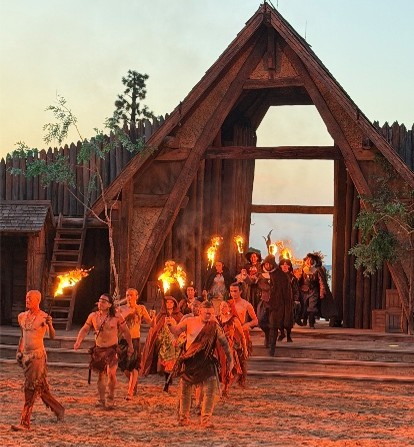
- Reexamining the Lost Colony: Through theater, they explored Roanoke Island’s history and reconsidered the traditional narrative surrounding the colony’s disappearance, including Native American perspectives often overlooked in conventional accounts.
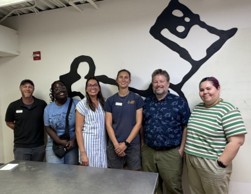
- Going behind the scenes at Historic Jamestown: The teachers received special access to the archaeological excavation, met archaeologists working in the lab and learned how newly discovered artifacts help researchers piece together the story of the settlement.
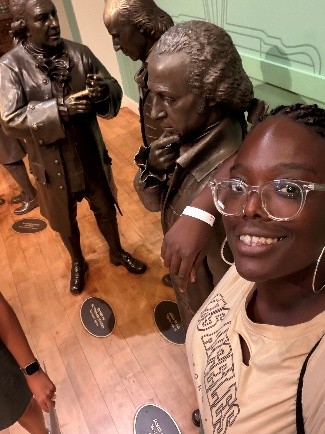
- Challenging assumptions in Colonial Williamsburg: An encounter with “Matthew Ashby” prompted them to examine more closely the complex relationships among race, freedom and identity in colonial America.Each experience offered an opportunity to look beyond simplified historical accounts and consider the people, perspectives and circumstances that shaped early America.
Turning Discovery Into Student Inquiry
Now, Nkiru and Valerie are translating their discoveries into a reimagined classroom unit designed to put students in the role of historians. Rather than simply memorizing dates and events, students will investigate evidence, weigh competing interpretations and develop their own evidence-based conclusions.
The unit will begin with a Roanoke Historical Mystery Inquiry, in which students examine photographs, maps, timelines, artifacts and primary sources to investigate the colony’s disappearance. Next, a Roanoke and Jamestown Comparative Investigation will challenge students to analyze how geography, leadership, resources, relationships with Indigenous peoples and other factors influenced colonial survival.
Graphic organizers and source-analysis tools will help students evaluate evidence and build well-supported arguments. The learning will culminate in a Student-Curated Colonial America Museum Exhibit. Students will select historical evidence, create visual displays, write explanations and arguments, and present their findings to an authentic audience of families and community members.
Through these projects, students will practice the work of historians: asking questions, analyzing sources, recognizing multiple perspectives and supporting claims with evidence. Just as importantly, they will have opportunities to consider whose experiences are represented in the historical record—and whose stories remain untold.
The goal is not to tell students what to think about democracy, but to equip them with the historical knowledge and critical-thinking skills to understand how it developed and to draw their own informed conclusions.
“Ultimately,” Valerie added, “the fellowship will extend beyond our students by creating resources, professional learning, and collaborative practices that can continue to influence how history is taught throughout our school community.”
For Nkiru and Valerie, the journey through America’s colonial past is just the beginning. By bringing firsthand discoveries into the classroom, they are helping students move beyond the noise of contemporary political debate to explore the history, complexity and enduring questions at the heart of American democracy.