 Back to Blogs
Beyond Words: Lessons in Language and Empathy
What happens when an ESL teacher becomes the language learner? For Pony Stacpoole-Gilmartin of Beechwood Knoll School in Quincy, MA, a four-week Fund for Teachers fellowship across the Balkans reinforced that communication requires more courage than perfection. Through unfamiliar languages and unexpected connections, Pony returned with renewed empathy for multilingual students and a commitment to helping them find their voices.
In the reflection below, Pony shares how curiosity, connection, and learning beyond the classroom are shaping her renewed approach to teaching.
If you could research anything, what would you research? If you could go anywhere, where would you go?
As an educator and an eternal student, I was fortunate enough to answer both of these questions and, through the generous support of Fund for Teachers, turn those answers into an extraordinary professional and personal experience.
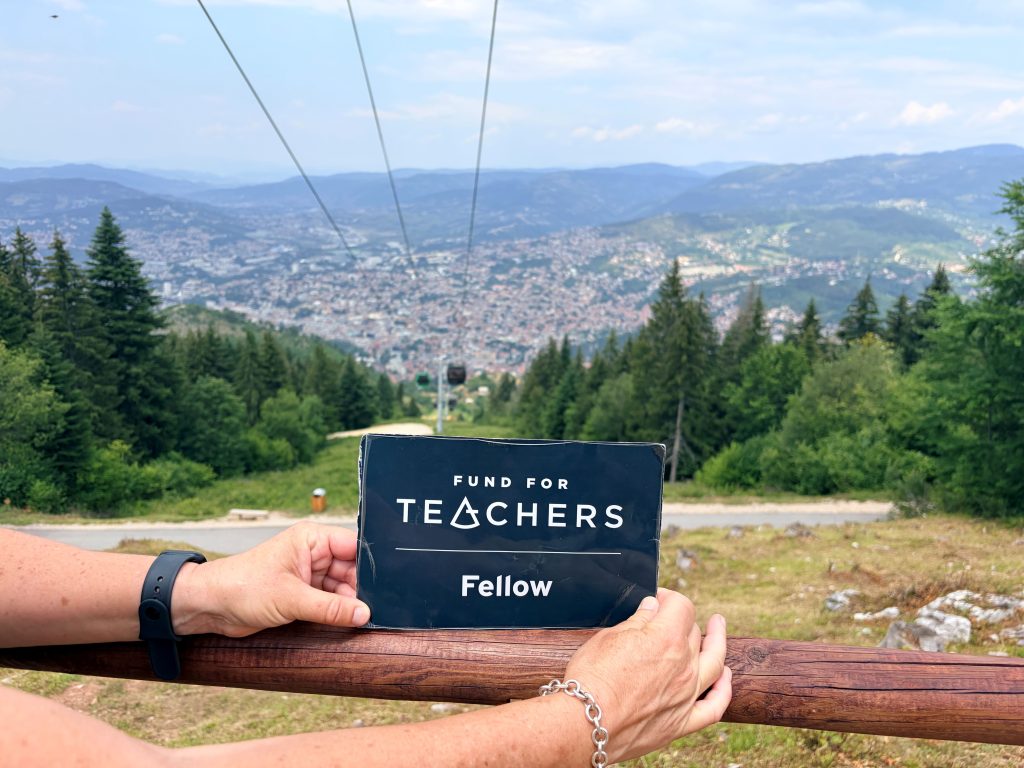
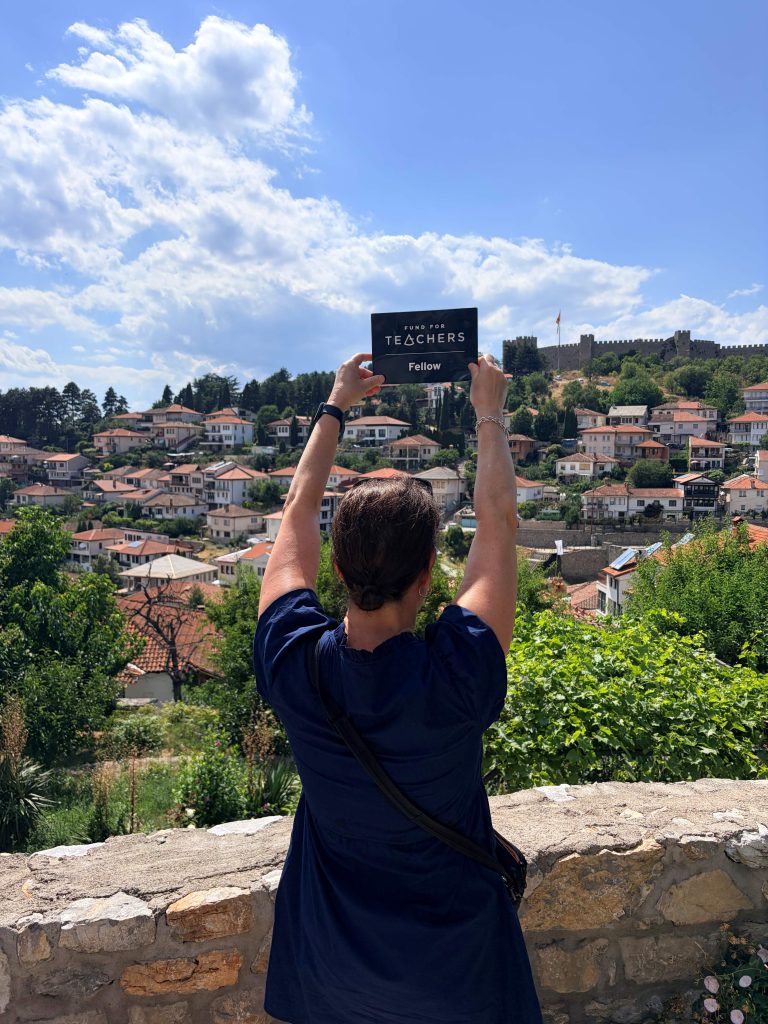
This past summer, I spent four weeks traveling throughout the Balkan region, from the crystal-clear freshwater shores of Lake Ohrid in North Macedonia to the graffiti-covered concrete of the 1984 Olympic luge track overlooking Sarajevo in Bosnia and Herzegovina. I spoke with a humble sheep herder at a village bus stop in Kosovo and with an eager young student desperate to try out his “American accent” as I explored an ancient fortress in Montenegro. These encounters, unexpected and often spontaneous, became some of the most meaningful moments of the journey as they highlighted that sometimes powerful connections can happen when words are limited and curiosity, kindness, and a willingness to communicate take their place
As an ESL teacher, empathy has long been the foundation of my pedagogy. I am an immigrant, and I have spent a significant portion of my life as an ethnic, cultural, and linguistic minority. As such, I understand the very real challenges faced by my students, not simply academically, but socially, culturally, and personally. This fellowship gave me the opportunity to once again experience what it feels like to be in a place that is completely foreign, where even the most ordinary tasks can become challenging, and where language, customs, and unfamiliar surroundings can create a constant sense of uncertainty. Navigating these experiences reminded me of the courage and perseverance required to function in an unfamiliar environment and renewed my understanding of what many of my students encounter each and every day.
Perhaps most importantly, however, was the reminder of the power of oral language. During my travels, communication was not defined by an understanding of grammatical rules, the ability to write a perfectly constructed sentence, or even the capacity to read a simple sign. It was found in shared greetings, in exchanges of hellos and goodbyes, and in broken English riddled with hesitation, pauses, and uncertainty that was nevertheless comprehensible. Meaning was created not through perfection, but through the willingness to try. Needless to say, I can now say “thank you” in six different Balkan languages. Thankfully, they are fairly similar.
These everyday interactions reinforced for me the importance of prioritizing oral language development in the ESL classroom. Students need opportunities to speak, take risks, make mistakes, and discover that communication does not require flawless English. Sometimes, a hesitant phrase, a gesture, or a simple “hello” is enough to create a connection. As educators, we must ensure that our students have those opportunities every day.
Ultimately, this experience reinforced what I value most about education: the belief that learning should never stop, and that the best educators remain students themselves. The grant enabled me to pursue a question that genuinely mattered to me, engage with communities across an extraordinary region, and return with knowledge that will continue to inform my teaching and professional practice.
It is important to remember that professional development can take many forms, but perhaps some of the most impactful learning comes through lived experience. Going, seeing, and doing was transformative. Fund for Teachers provides educators with the opportunity for independent learning, limited only by the questions we are willing to ask and the possibilities we are willing to pursue. I would encourage any teacher with a passion for learning, a compelling question, or an idea worth exploring to take advantage of this extraordinary opportunity.
So, if you could research anything, what would you research? If you could go anywhere, where would you go?